
Missouri DOC Release Destinations
The Missouri Department of Corrections operates the statewide prison and community-supervision system. A sentenced prisoner can leave an institution on parole, conditional release, transfer, or discharge. Those outcomes are not equivalent. Parole is a Board-authorized prison release with supervision. Conditional release is the supervised part of an eligible sentence under Missouri law. A transfer moves the person between custodians or institutions. Discharge usually marks the end of DOC authority for the covered record.
A Clinton County Jail departure to MODOC establishes continuing custody, not community release. The official sheriff site identifies the local agency channel, while the sheriff-selected portal checks current county custody. The booking-disposition record should name the receiving agency. Later prison release must be confirmed through MODOC. If parole or conditional-release supervision remains active, the public offender record may list a field office or supervision unit. A fully discharged person may have no public name-search result.
| DOC event | Where the person goes | Best confirming record |
|---|---|---|
| Parole | Community under MODOC supervision | Active offender detail and Board decision |
| Conditional release | Community for the supervised sentence portion | Active offender detail and movement record |
| Institution transfer | Another correctional institution | DOC movement history |
| Full discharge | DOC authority ends for the completed episode | All-offender data, court record, or DOC response |
Missouri DOC Active Release Search
The MODOC Offender Web Search covers active offenders, including incarcerated people, probationers, and parolees. Its warning expressly says discharged-offender information is not provided. A released person can therefore appear because parole or conditional-release supervision continues. A probation result does not prove a prison stay, since probation can follow a court judgment without incarceration in a state institution.
Search by DOC ID when available. It is a lifetime unique identifier and offers the strongest match. A name search accepts first and last name and can include aliases. Compare the DOC ID, birth or age information, offense and sentence county, legal status, assigned place, and institution or field-office information. Do not merge two people based on a common name.
- Enter the DOC ID or exact name and review possible aliases.
- Open the matching record only after comparing identity and sentence details.
- Copy the exact legal status and each complete date label.
- Note whether the assigned place indicates an institution or field supervision.
- Confirm a specific status or date with the institutional caseworker or assigned field office.
The official search warning shown below is central to interpreting Clinton County state-release research. It establishes that the public tool is an active-record source rather than a complete historical index.
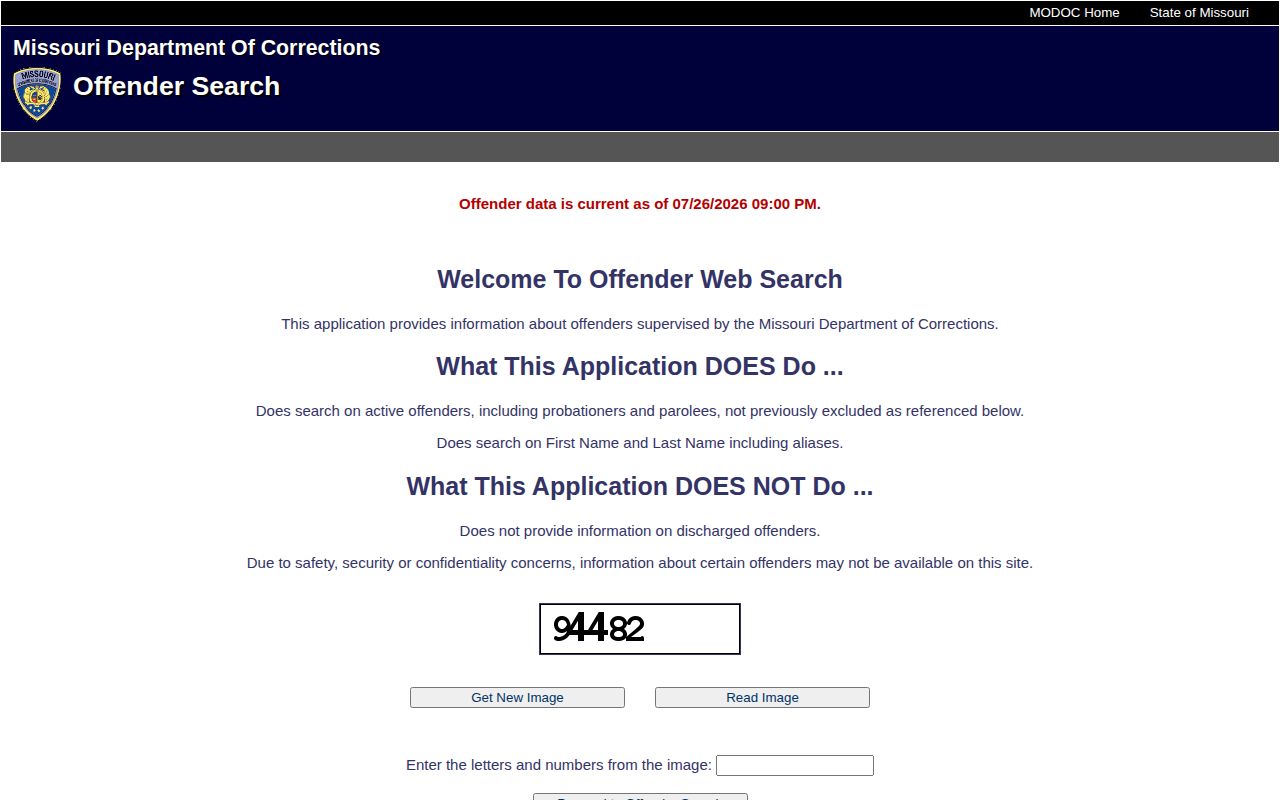
The warning explains why an active parole record can appear while a fully discharged record may not.
Finding Fully Discharged Missouri Offenders
Missouri uses a distinctive two-channel design. The public name search affirmatively excludes discharged offenders. Separately, the MODOC Sunshine page publishes a nightly current-and-prior all-offender file. That historical channel is the main public fallback when a former prisoner no longer appears by name.
The file is not a simple search-results page. Download the current field documentation with the data. Use DOC ID as the strongest key, then corroborate name, birth details, sentence county, offense, and related rows. Save the file update date and dictionary version. The documentation says the data reaches back to approximately 1974, but older cases, name changes, conversion issues, and confidential exclusions can complicate matching.
The Sunshine channel and data dictionary appear together in the official source captured below. Both are needed because coded fields should not be interpreted from their names alone.
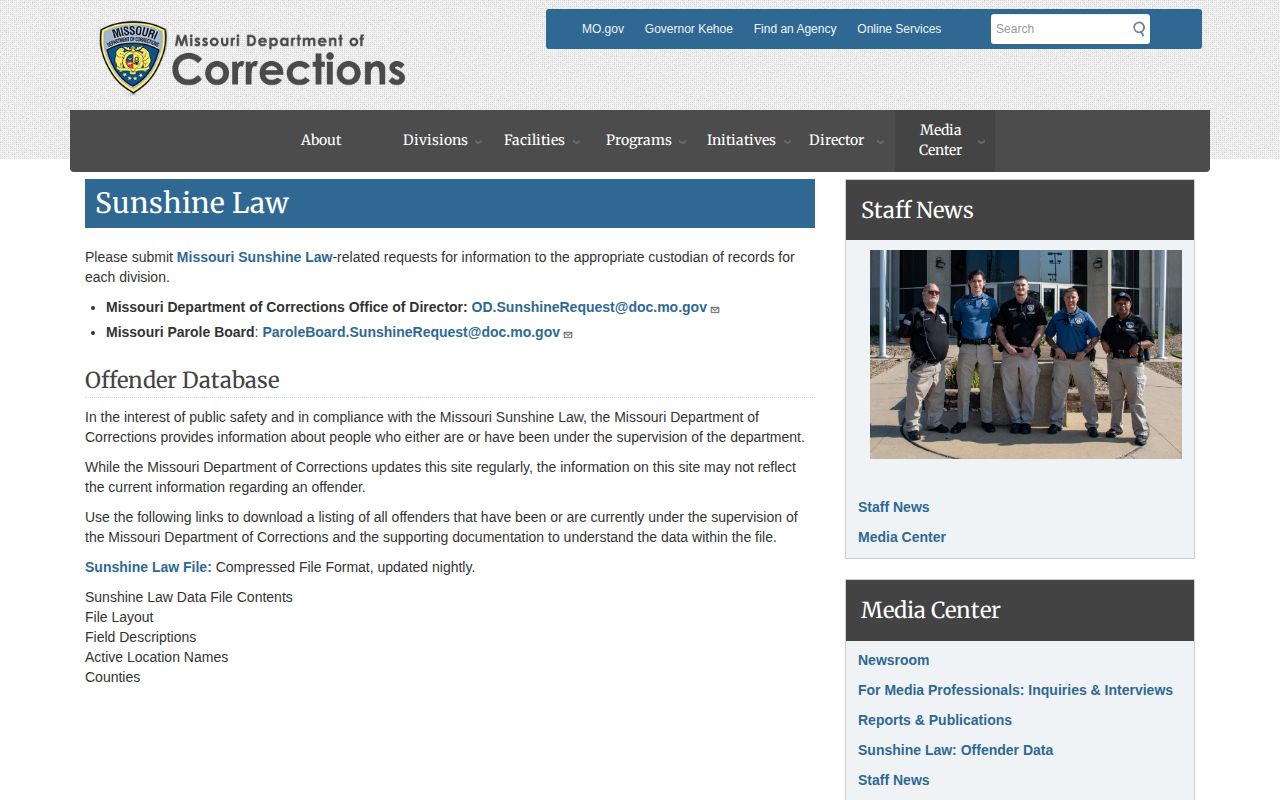
The file can establish prior MODOC authority and documented completion fields. It does not supply the exact time a Clinton County jail booking ended.
Missouri DOC Release Data Fields
A person can have multiple charge and sentence rows. Read fields in their record context. A completed charge row does not necessarily mean every sentence or supervision episode is complete. MODOC also cautions that data may be incomplete or not current and that some biographical facts may be self-reported.
| Field | How to interpret it |
|---|---|
| DOC ID | Lifetime unique identifier and strongest record-matching key. |
| Assigned place / institution-field indicator | Helps distinguish confinement from field supervision. |
| Sentence county and court number | Connects the state record to the correct court case. |
| Sentence Minimum Release Date | Calculated minimum date on an active sentence, not automatic proof of release. |
| Sentence Maximum Release Date | Maximum expiration, subject to lawful calculation and field coding. |
| Completed Flag | Must be read for the corresponding row; it may not close every episode. |
Some date values are sentinel codes for life, indeterminate or interstate cases, or assessment situations. They are not ordinary calendar dates. For a high-confidence historical result, combine DOC ID and completion or date fields with Case.net and an agency records response.
Missouri DOC Release Date Meanings
A conditional-release date is tied to the statutorily supervised portion of an eligible sentence. A minimum release date in DOC data is the calculated conditional or minimum point described by the field documentation. A maximum release date is full-term expiration. A presumptive parole release date is tentative and depends on institutional conduct and an acceptable release plan.
A future date can change because of discipline, sentence recalculation, new judgments, detainers, required programming, or Board action. A parole hearing date is not a release date. The Board may set a future date, deny release and schedule later review, continue a matter, or alter an earlier date as authorized.
RSMo § 558.019’s 85% minimum is not universal. It concerns a person committed to DOC for a legally defined dangerous felony, subject to the applicable statute and exceptions. Other offense rules may apply. Do not use it for every Missouri sentence or a county-jail bond release.
Missouri DOC Supervision After Release
MODOC’s Division of Probation and Parole supervises parolees, conditional releases, probationers, and interstate-compact clients. District 2 serves Clinton County. Its District 2S Cameron office is at 207 East McElwain, Suite B, Cameron, Missouri 64429, telephone 816-632-3781. A Clinton County guide also identifies a Plattsburg courthouse reporting location. The person under supervision should follow the officer’s current instructions.
An absconder status generally concerns lost contact or failure to report. It is not proof of present incarceration. Check the active offender record, court docket, and any issuing agency. Likewise, Earned Compliance Credits under § 217.703 can reduce eligible community-supervision terms. They are not prison good time and should not be used to predict a prison release date.
Public confirmation requests can ask whether a person is under supervision, the supervision type, term, office location, and certain status or date information, subject to law and policy. Medical, treatment, victim, presentence, and protected case-plan material should not be requested as part of a routine status check.
Missouri DOC Release Record Requests
When the online channels do not answer the question, use the division-specific contacts on MODOC’s Sunshine page. Give the full name and DOC ID. Ask for movement history, prison release type and date, sentence data, supervision start and end, and other publicly releasable fields. Parole Board records go to the Board’s listed Sunshine custodian. For the earlier county transfer event, the Clinton County Sunshine route identifies the centralized request channel while noting that each office handles its own records.
Missouri’s Sunshine Law requires the custodian to act as soon as possible and generally by the end of the third business day. That is a response deadline, not a guarantee that records will be produced within three days. Ask for native electronic records, a fee estimate, and notice before costs exceed a chosen limit.
Section 217.075 limits release of some offender information, especially medical, mental-health, and treatment material. Victim, security, presentence, and protected supervision information may also be closed. Ask for segregable open portions and the specific legal basis for a denial.
Central office: 573-751-2389
Constituent Services: 573-526-2695
constituentservices@doc.mo.gov
Cameron Prison Names and Releases
Cameron spans Clinton and DeKalb Counties, but the historic Crossroads and Western Missouri correctional campuses are in DeKalb County. They must not be listed as present Clinton County detention facilities. MODOC reports that the last Crossroads prisoners transferred out on July 12, 2019. It describes former Western Missouri Correctional Center space as a training academy.
The MODOC Crossroads history records the last transfer, and the department’s Western Missouri account identifies the training use. Old facility directories, offender pages, and search results can therefore create two errors. They may assign the prison to the wrong county, and they may treat an old institution reference as current custody. A historic result should be traced through DOC ID, movement history, the all-offender file, and the court case. The 2019 transfer was not release to the community.
This local distinction also affects arrest research. “Cameron” alone does not identify the arresting county, jail, court, or custody level. Confirm the agency and actual facility before selecting a record system. The Clinton County released-inmate search begins with that custody-level check.
Missouri DOC Versus Federal Release
MODOC does not hold the complete record for federal prison or immigration custody. A federal prisoner uses the BOP locator, which may show “Released” and a date for covered records. An ICE search uses A-number and country of birth or biographical information, with limited recent-release coverage and important no-result limits. The U.S. Marshals Service has no comparable public historical person locator.
A Clinton County jail handoff to BOP, ICE, or USMS remains a transfer unless the receiving authority confirms a later community release. Use the sheriff disposition, federal docket, and the appropriate federal custodian. Do not convert departure from one system into discharge from all government custody.