
Clinton County Projected Versus Actual Release
A projected date is a current calculation or future action point. It can be useful, but it is not proof that the person has left custody. Missouri records use several labels with different legal meanings. Minimum parole eligibility marks when Board consideration may become possible. A presumptive parole release date is a tentative Board-set date subject to conditions. A conditional-release date concerns the supervised portion of an eligible sentence. A maximum release or discharge date addresses sentence expiration, not necessarily the prison exit.
The actual event is recorded after the releasing agency completes its process. For the Clinton County Jail, the booking or release-disposition record should show the physical departure date and time, reason, and any receiving custodian. For MODOC, an offender record, movement history, supervision entry, or records response can establish the prison transition.
A person can also leave one facility and remain detained. A transfer from Clinton County Jail to MODOC, another county, the U.S. Marshals Service, or ICE is a change of custody, not community release. Always read the destination field.
Find a Clinton County Projected Release
Start by separating a county booking from a state prison sentence. The sheriff-selected portal is a current-custody check. It does not promise a future release calculation. Case.net may show a bond change, release order, sentence, jail credit, commitment, or warrant. The jail records the later physical event. For a state sentence, the MODOC Offender Web Search covers active offenders and may display sentence or release-related labels on the live detail.
- Identify the custodian. Confirm whether the person is in Clinton County Jail, a Missouri prison, federal prison, or another agency’s custody.
- For a county booking, review the court case for the legal order, then call the jail at 816-539-2156 about holds and physical processing.
- For a state prisoner, search by DOC ID when known. Copy the exact date label, legal status, institution, and displayed “as of” context.
- Ask the institutional caseworker or parole office to confirm what that label means for the named sentence and whether later action affects it.
- After the date passes, verify the actual release or transfer through the agency event. Do not rely on an old screenshot or prior calculation.
MODOC warns that its public search provides general information. It includes probationers and parolees as active offenders and excludes fully discharged people. A probation record can exist without a prison stay. A missing result may mean full discharge, no MODOC history, a spelling mismatch, or another data limit.
The official MODOC search warning shown below sets the limit for Clinton County release-date research. It should be read before treating a name result or no-result as a custody conclusion.
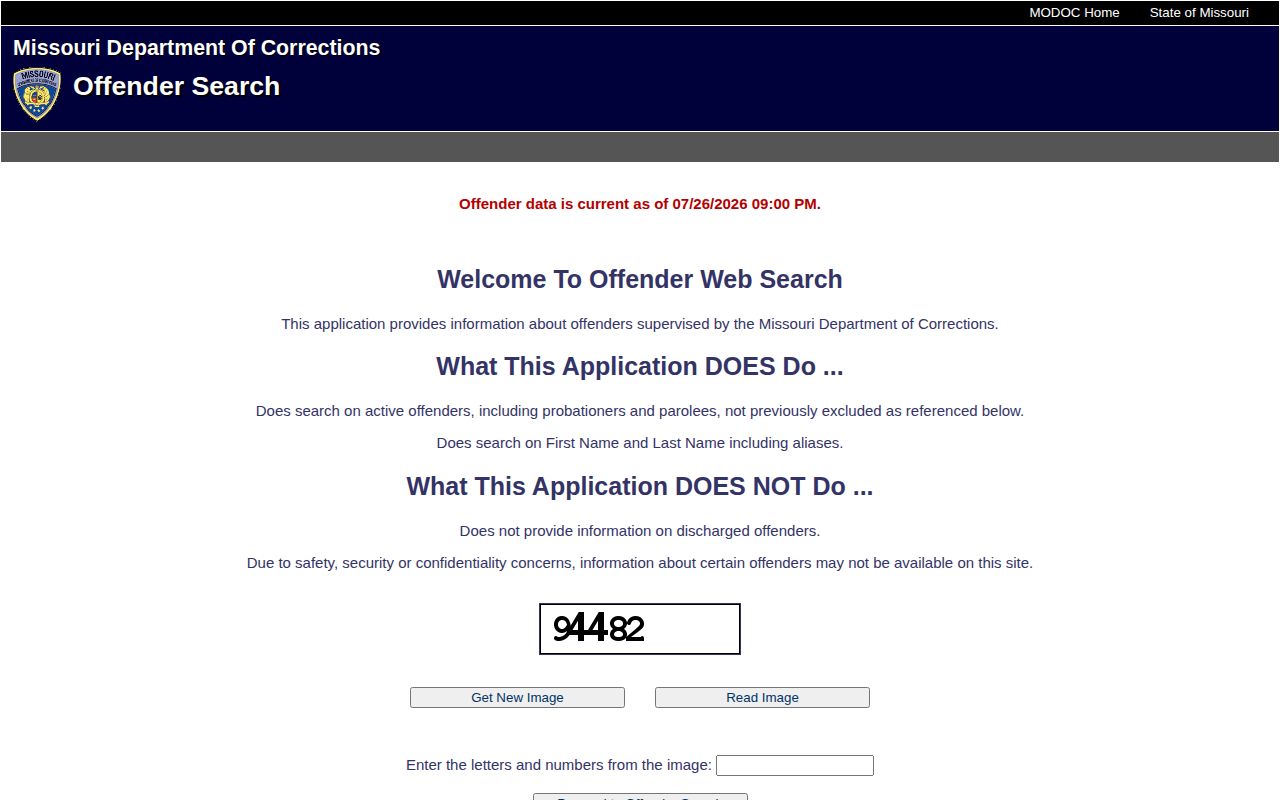
The screenshot demonstrates the active-search channel. Fully discharged Missouri offenders require the separate historical route.
Missouri Release Dates for Clinton County
Missouri’s date terms are not interchangeable. The MODOC glossary and data documentation distinguish conditional, minimum, maximum, and presumptive dates. Copy the whole label. A shortened note such as “release date” can erase the distinction between eligibility, a tentative Board decision, a statutory conditional point, and the end of a sentence.
| Date label | Meaning | What it does not prove |
|---|---|---|
| Minimum or eligibility date | A calculated minimum or point when release consideration may arise. | That release was granted or completed. |
| Presumptive parole date | A tentative Board-set date dependent on conduct and an acceptable plan. | An unconditional promise of release. |
| Conditional release date | The date tied to the supervised part of an eligible sentence. | That no extension, hold, or other judgment applies. |
| Maximum release date | The maximum sentence expiration shown in DOC data. | That the person stayed in prison until that date. |
| Actual release event | The recorded departure or transfer completed by the custodian. | Release to the community unless destination also confirms it. |
The all-offender data field called Sentence Minimum Release Date is a calculated minimum date on an active sentence. Sentence Maximum Release Date represents maximum expiration. Sentinel values can denote life, indeterminate or interstate matters, or assessment rather than an ordinary date. Read the current data dictionary with the file.
Clinton County Jail Release Timing
A pretrial detainee often has no set release date. A judge may change bond or issue an order, but the jail must receive and process it. Another court, county, state, or federal agency may have an active hold. For a local sentence, the judgment, jail credit, sentence end, and sheriff processing control. MODOC’s prison formulas should not be applied to an ordinary county booking.
Use Case.net to find the Clinton County or 43rd Circuit case and read the docket carefully. “Disposed” means the court resolved the matter at that stage. It does not prove physical departure. “Bond posted” or a release order can precede the actual jail event. A commitment to DOC explains departure from the jail while confirming continued government custody.
Use the official Clinton County sheriff site to confirm the agency channel, then call the jail at 816-539-2156 and ask: Has the order arrived? Is another hold active? Has the person physically left? If transferred, which agency received custody? No authoritative local source establishes a standard release hour, weekend schedule, exit door, or family waiting location. Staff instructions at the time control.
A precise request can reconcile the docket and jail event. Ask for the booking number, release date and time, release disposition, and receiving agency, if any. Include the arrest or booking date so staff can identify the right episode. The Clinton County Circuit Clerk is the local source for the matching judgment or docket record. When the court grants bond or enters a time-served judgment, save that docket date separately from the later physical departure time. Those two times answer different questions.
Clinton County’s 85 Percent Question
Missouri’s 85% rule is offense-specific. It is not a formula for every felony, every MODOC sentence, or any ordinary county-jail term. RSMo § 558.019 applies the minimum to a person committed to DOC for a dangerous felony as legally defined, subject to the statute’s text and exceptions. The dangerous-felony definition is found in § 556.061 and can change. The offense date and applicable statutory version matter.
Other laws can create offense-specific minimums. Concurrent and consecutive sentences, prior commitments, jail credit, new judgments, and Board authority also affect the result. A broad statement that “Missouri inmates serve 85%” is wrong. Good-time or other credit concepts cannot override a mandatory minimum.
This distinction is especially important in Clinton County. A bond release, recognizance order, time-served county sentence, or dismissal is controlled by the local case and holds. None should be run through a dangerous-felony prison calculation.
Clinton County Conditional Release Calculations
RSMo § 558.011 supplies a conditional-release structure for eligible Missouri sentences. For qualifying terms outside excluded categories, the supervised portion is generally the last one-third of a term of nine years or less, three years for a term over nine through fifteen years, and five years for a term over fifteen years. The imprisonment portion is the remainder. The Board may extend a conditional date toward the full term through the statutory process for rule violations.
That structure is not a safe do-it-yourself release calculator. Sentence aggregation, consecutive or concurrent terms, jail credit, offense-specific minimums, offense dates, Board action, detainers, and new judgments can change the outcome. A record may also use a minimum, presumptive, conditional, or maximum label with a narrower meaning.
- Detainer
- A request or legal basis for another authority to assume or maintain custody.
- Jail credit
- Time a court or corrections calculation credits toward the sentence when legally applicable.
- Presumptive date
- A tentative Board release date, still subject to stated conditions and later action.
- Maximum date
- The calculated end of the full term, not necessarily the prison exit.
Why Clinton County Release Dates Change
A future date reflects the facts and legal rules loaded at that time. MODOC Victim Services explains that most non-life sentences include confinement and supervision, and that a conditional date is determined by law. Later information can alter the calculation or prevent release on the date once shown.
| Factor | Possible effect | Best confirmation |
|---|---|---|
| Disciplinary action | Can affect eligibility or extend a conditional date through lawful process. | Institutional caseworker or current DOC record. |
| Sentence recalculation | Can change credit, aggregation, or displayed minimum and maximum dates. | MODOC sentence records. |
| New judgment or hold | Can keep the person in custody after the prior date. | Court docket and holding agency. |
| Board action | Can grant, deny, defer, alter, or rescind a future parole date as authorized. | Exact Board notice or open Board record. |
| Required programming | Can affect whether stated release conditions are met. | Institutional caseworker. |
| Transfer | Changes location or custodian without community release. | Movement history and receiving agency. |
Clinton County Credits After Release
Missouri Earned Compliance Credits under § 217.703 concern eligible community supervision. They are not prison good time. An eligible probation, parole, or conditional-release client may receive a reduction for compliant months. Absconder status, a violation, custody, or revocation activity can stop accrual. MODOC makes the final calculation under the statute.
These credits can affect the later supervision discharge date. They do not predict the prison gate date and should not be used to revise a conditional or presumptive prison release date. First identify whether the person is incarcerated or already under supervision.
Confirm Clinton County Actual Release
Capture the exact live label and access date, then contact the responsible office. For a state prisoner, ask the institutional caseworker or parole office whether the date remains current and what conditions still apply. For a county booking, the jail’s release-disposition event controls the physical departure.
MOVANS can provide custody and court-event notifications within its coverage. Current local-jail registrations use SMS or email. A notice still needs agency confirmation because a closed custody episode may be a transfer. For DOC victim notifications, the Office of Victim Services uses a separate rights-based process.
After the expected date, verify three items: the actual event time, release type, and destination. If the person entered parole or conditional-release supervision, the active MODOC record may show that status. If fully discharged, use the nightly all-offender data, the sentencing case, or a MODOC records request.
For an unresolved state date, a records request should identify the DOC ID and ask for the current sentence calculation, movement history, release type, supervision start, and publicly releasable explanation of changed date fields. Keep the version date of any downloaded data dictionary. A minimum or maximum value taken from an older file can become stale after a recalculation. The current agency response and the matching judgment are stronger than a date copied from an undated third-party page.